QSDB contains hand-curated information of about 365 sensing and quenching relations between organisms and chemical signal molecules (348 sensing, 17 quenching), with 123 listed organisms and 50 signals, making it the largest and most up-to-date collection of this information worldwide. All information is presented using established standards in systems biology, in particular SBGN for the graphical representation. All information was extracted manually through an extensive survey of literature and online databases and is linked to PubMed and PubChem. In addition to the sensing indication, the database provides detailed information on the type of evidence, the response, sequence identity, effects, and receptors involved. For all entries, evidence references are given.
The webinterface supports interactive access to the QSDB data via direct selection or searching in the database. It is divided into three main pages, the overview and search page, a data table page, and a heatmap page. A navigation area at the top of each page allows to switch between them.
Overview page The overview page allows you to select or search for entries in the database, and presents static diagrams of sensing mechanisms as a result. It is divided in the following main areas (see image below):
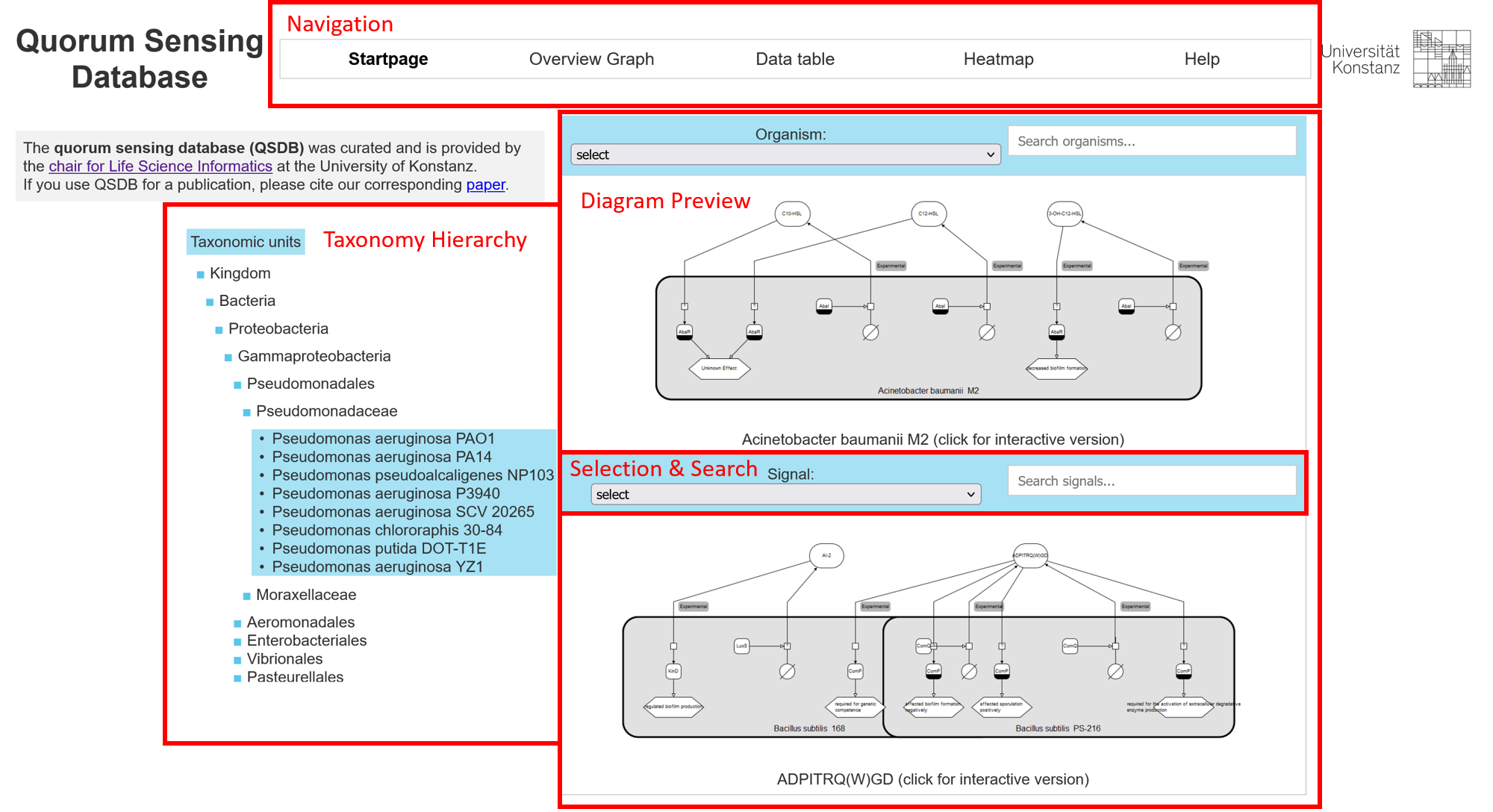
The search area comprises drop-down lists for organisms and signal metabolites. On selection of a drop-down option, the corresponding organism / signal metabolite's information is retrieved and a preview of the sensing diagram is shown in the preview area.
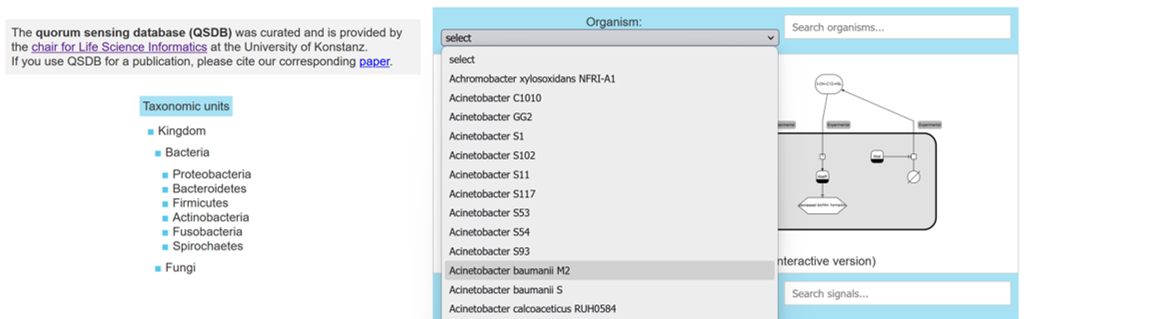
In addition to the drop-down lists, the search area contains a free-text search, where you can enter a stub of an organism or metabolite name to search for in the database. As an alternative, you can use the treeview in the taxonomy hierarchy area to select an organism.
If a species is selected, all known sensed metabolites and the known sensing mechanisms are shown in the diagram. If a signal is selected, all organisms that sense the signal are added to the diagram with the corresponding information on the sensing mechanism.
From the diagram previews on the overview page, you can navigate to interactive versions of the diagrams by clicking on the corresponding image. A new page opens that shows the interactive image version depicting the sensing mechanisms, and where PubMed and PubChem information on evidence, species and signals can be retrieved by clicking on the respective entity. The diagram adhers to the SBGN notation standard. Below the interactive diagram a table presents the corresponding information. Evidence references are given as entries in the table, and clicking on the entries links to the publications's PubMed entries.
The overview image is linked to an interactive diagram that shows the full data set in a combined SBGN diagram that holds interactive links to PubChem entries for the signal metabolites.
Data Table page The data table page presents the raw data in a table layout, including sensing mechanism, type of evidence, the response, sequence identity, effects, and receptors involved. For all entries, evidence references are given. You can sort the data by according to any of the entries by clicking on the respective table header.
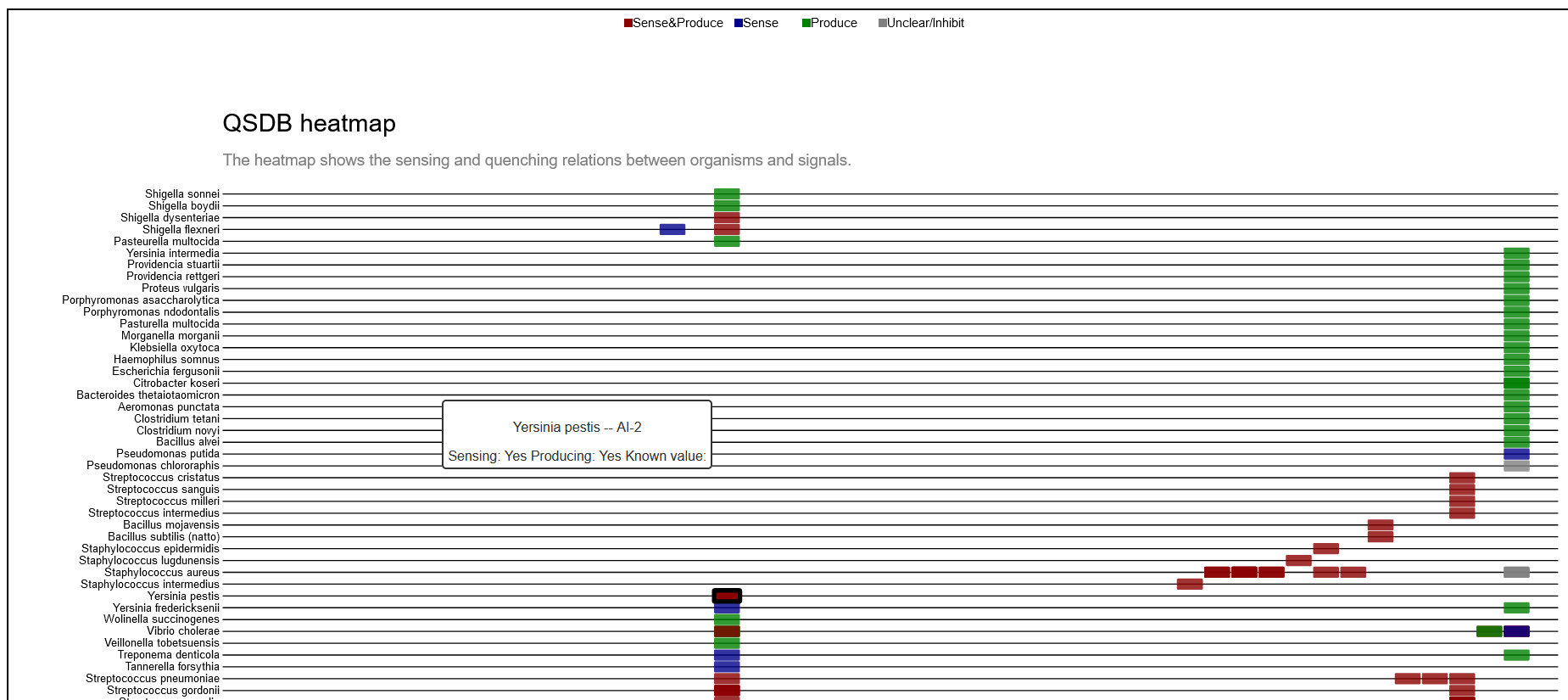
Heatmap page The heatmap page shows a graphical representation of the sensing and quenching relations between organisms and metabolites in a table-style layout. Signal molecules are listed along the x-axis, and the organisms are listed along the y-axis. Each colored map entry represents a known sensing or quenching mechanism between the corresponding organism and molecule. The color code gives further information on the type of relation, as explained by the heatmap legend. Clicking on the heatmap entry leads to the PubMed entry for the corresponding evidence publication reference. If no evidence reference can be given, the heatmap entry links to a pubmed search that includes species and signal.